Structural Fittings & Brackets
Mounting hardware where the load path is complex and every gram saved propagates. Printed in titanium or aluminium, machined at the interfaces.

An aircraft or a UAV carries everything it carries, forever, and it carries it in the air. That single constraint is why additive manufacturing exists in this sector: a part that is lighter, stronger and simpler at the same time is not a nice-to-have, it is the whole design. And at low volume — which is what flight hardware is — printed metal is often the only way to build the geometry you actually want.
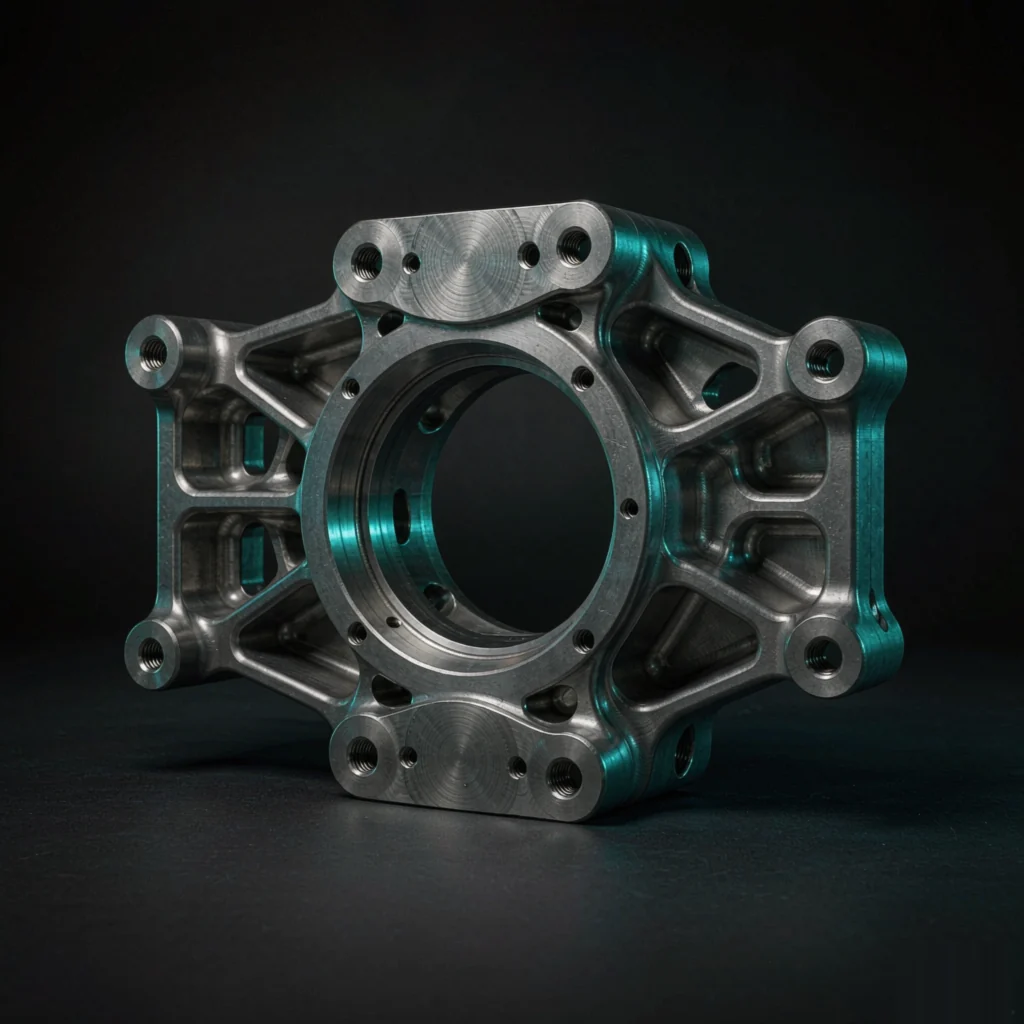
The governing number in aerospace is mass, and it governs everything else. Every gram you remove is a gram the aircraft does not carry for the whole life of the part, which is why a printed bracket that is lighter and stiffer than the machined one it replaces is not a cost decision — it is a fuel and range decision. Topology optimisation and printed internal geometry let the load path be exactly as thick as it needs to be and the rest simply absent, which is a shape you cannot cut.
The second constraint is traceability. Aerospace parts get documented, and material matters: which alloy, which lot, which build parameters. We record alloy and lot per part, and we will say plainly when a job needs certified material with a mill certificate, or hot isostatic pressing for fatigue-critical work — neither of which we do in-house. A claim of certification we cannot back is worse than an honest boundary.
The third is that interfaces are the hard part, not the geometry. A printed fitting has to bolt to a machined part, seat an o-ring, take a bearing, and stay within tolerance after assembly. So the useful division is the same as everywhere else: print the structure, machine the features that need a precision surface. Threads, bores, seal faces and bearing seats are quoted with the print rather than discovered afterwards.
What we would not do is print primary structure or anything certified to carry a person. We print fittings, brackets, ducting hardware, heat-exchanger shells, tooling and non-load-critical UAV frames — the parts where lightening and consolidation win. We will tell you when a part has drifted into territory where a qualified supplier and a full material certification trail are what the project needs.
Low-volume metal parts where mass and part count both matter. Most of these consolidate several machined pieces into one, and most of them carry a load path through geometry that has to be organic.
Mounting hardware where the load path is complex and every gram saved propagates. Printed in titanium or aluminium, machined at the interfaces.
Internal channels and branching passages that would be drilled, brazed and leak-tested in metal. One printed body removes most of the joints.
Topology-optimised frames where stiffness has to be highest exactly along the load line and absent everywhere else.
Fin and channel geometry in aluminium, printed for surface area and conduction path rather than shape alone.
Arms, motor mounts and landing-gear brackets in PA12 nylon and glass-filled nylon, and in aluminium where the motor mount carries real load.
Build and inspection tooling that changes with the programme — usually nylon, made in a day, modified in an hour.
Guides and mounts with the channel built into the part, so a loom is protected by structure rather than clipped to it.
One-off or small-batch spares for equipment that is older than its documentation, where a machined replacement takes weeks to source.
See the parts gallery for examples across SLM, SLA and SLS, grouped by process.
Tolerance and lead time are read from the process pages, so these are the same figures the quote engine works to — not a second copy that can drift.
| Process | Why it fits this sector | Typical tolerance | Typical lead time |
|---|---|---|---|
| SLM Metal 3D Printing | Structural fittings, ducting and lightened brackets. Titanium where strength per gram and corrosion resistance decide it, aluminium where the thermal path or the budget does. Internal channels and consolidated geometry come free. | ±0.2 mm | 7–10 days |
| SLS Nylon 3D Printing | Tooling, jigs, cable guides and non-structural UAV parts in PA12 nylon. No supports at all, so a complex bracket prints as one piece whatever is inside it. | ±0.3 mm | 3–5 days |
| SLA Resin 3D Printing | Fit models and mock-ups for the assembly cell, and any part with a fine feature or a smooth surface. Also the fastest route to a shape in your hand for a design review. | ±0.1 mm | 2–4 days |
These are typical values we hold routinely, not absolute limits — send us the drawing and we will confirm what is achievable on your geometry. Compare all processes, or see post-processing & finishing for what happens after the print.
Two alloys cover most of it: titanium for strength per gram, aluminium where the thermal path matters or the mass target is looser.
The reference SLM alloy. Highest strength-to-weight of anything we print, and effectively immune to salt water. The default for robot joints, aerospace brackets and non-implant medical instruments.
Full material data →Low density, useful strength and excellent thermal conductivity. The material for weight-critical brackets, heat sinks and RF housings in automotive, drones and electronics.
Full material data →Tough, chemically resistant and dimensionally stable, and it prints with no supports to remove. The default material for functional prototypes, brackets, housings and low-volume end-use parts.
Full material data →Up to 100 % IACS electrical conductivity and ~400 W/m·K thermal, in three-dimensional geometry that machining cannot produce. The hardest metal to print — and quoted only after an engineer reviews the part.
Full material data →Inconel 718 is the hot-section one — it handles temperatures where the other two are not the answer. Send the temperature and the load case early and we will tell you whether it is realistic in our process or whether a specialist supplier is the better route for you.
On structural and flight hardware the decisions that matter are taken before the machine starts. These are the ones we take with you.
In this sector an overstated claim does real damage, so this is the honest list. Ask us where your part sits on it.
No, and we will not imply otherwise. We print fittings, brackets, ducting hardware, thermal shells, tooling and non-load-critical UAV frames — the parts where lightening and consolidation win. Anything certified to carry a person, or requiring a full material certification trail, belongs with a qualified supplier. Where a job needs certified material with a mill certificate, we will tell you what that means for your route before you commit to it.
Titanium Ti-6Al-4V when strength per gram and corrosion resistance decide the design, which is most flight fittings. Aluminium AlSi10Mg when the part also has to move heat, or when the mass target is looser and the budget is tighter — it is lighter per unit volume but weaker and less stiff. Send the load case, the temperature and the mass budget and we will tell you which one we would pick, and where the part is marginal.
We print a pilot and machine it afterwards. A printed surface is rough and its tolerance is an order of magnitude looser than a bearing seat or a sealing face needs, so printing the feature and hoping is how a fitting ends up leaking. The machining step is quoted with the print, not discovered later.
Yes, and it is one of the reasons printing wins here. The constraint is that un-melted powder has to be evacuated, so every channel needs a clear escape path from outside the part — a fully sealed internal void cannot be cleared. Design the channels with drainage and powder traps and we will build it.
Flight hardware is usually one part, then spares or a replacement batch. Up to tens of pieces the price per part is stable, because the cost is machine time and material rather than tooling. When the volume starts to argue for forging or machining we will say so — that decision should be made with the number in front of you.
Yes, and we would rather sign one than not. Files are treated as yours, access is limited to the people planning and running the build, and we do not show client parts in our own marketing without written permission. Flight geometry is competitive advantage and, in some cases, controlled — we treat it that way and we will ask what your programme requires before we handle it.
A STEP file if you have one, plus the load case, the temperature it sees and the mass target. If the design is still moving, send what exists and describe the constraints — we will tell you which features are printable as drawn and which need a change before it is worth quoting.
We will tell you which process and alloy we would use, where the part is marginal, and what we would machine rather than print. If it belongs with us you get a price and a build plan; if it does not, we will say so.
Built for global product teams · Worldwide shipping via DHL / FedEx / UPS