
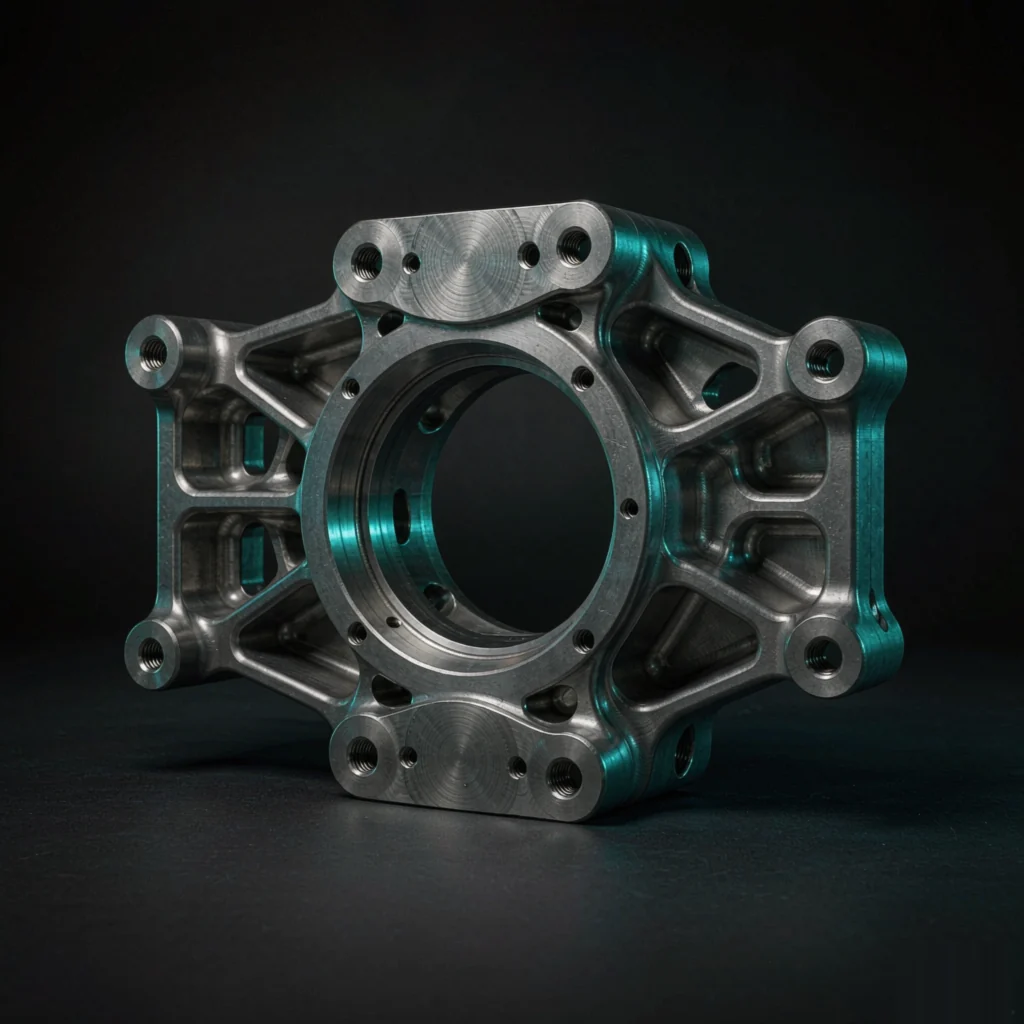
Aerospace & UAV
Lightweight structural fittings, ducting and drone frames in titanium and aluminium — where every gram saved is a gram carried, and traceability matters more than price.
Six sectors, six different definitions of "good enough". Each page states which processes we would actually use, what the part has to survive, and where additive manufacturing is the wrong answer — so you can tell in about a minute whether we are the right supplier.

Each page below states which processes we would use, what the part has to survive, and where additive manufacturing is the wrong answer.

Lightweight structural fittings, ducting and drone frames in titanium and aluminium — where every gram saved is a gram carried, and traceability matters more than price.

Appearance models, functional prototypes and short-run housings for designers, hardware startups and engineering teams. Iterate on Monday, hold it on Thursday.

Non-implant orthoses, surgical guides and anatomical models in biocompatible resin and sterilisable metal — precise, patient-specific, low volume.

Collector figures, cosplay armour, film props and bespoke jewellery — high-detail SLA and metal finishes with premium surface quality.

A strategic focus for LASEM — joint actuators, lightweight skeletal frames, end-effectors and custom structural parts, in metal and polymer to spec.

Conformal-cooled injection inserts, jigs, fixtures and replacement parts in SLM metal — the quiet backbone of low-volume production.

Prototypes, interior trims, wind-tunnel models and lightweight chassis parts for tuners, EV startups and race teams — beyond the OEM supply chain.
The starting point, not a rule. Plenty of jobs use two processes, and we will say so when the honest answer is "either".
| Industry | SLA | SLS | SLM | First choice |
|---|---|---|---|---|
| Aerospace & UAV | Yes | Yes | Start here | SLM metal |
| Product Design & Prototyping | Start here | Yes | Yes | SLA resin |
| Medical Aids & Custom Devices | Start here | Yes | Yes | SLA resin |
| Film, Props & Cosplay | Start here | Yes | — | SLA resin |
| Humanoid Robotics & Automation | Yes | Yes | Start here | SLM metal |
| Industrial Tooling & Machinery | — | Yes | Start here | SLM metal |
| Automotive & Motorsports | Yes | Start here | Yes | SLS nylon |
"First choice" is where we would start for a typical part in that sector — not the only process that will work. Send the part and we will tell you which one we would actually run.
Four questions in this order. Answering them is usually faster than sending a drawing — and it stops a quote being built on the wrong assumption.
Structural, fluid, cosmetic or thermal. That one answer removes most of the process options immediately.
Load, temperature, cleaning cycle, wear, impact. A part that has to be autoclaved or sit next to a manifold is a different part from the same shape in open air.
One piece and a hundred pieces take different routes, and the date decides whether that matters. Tell us the deadline and we will tell you if it fits.
STL, OBJ and 3MF are priced in the browser. STEP goes to an engineer. No drawing? Send the physical part and we will measure it.
The pages behind these industry pages — processes, materials and the work that happens after printing.
SLA resin, SLS nylon and SLM metal — what each one is good at, and the numbers it holds.
All services →Property tables for titanium, stainless steel, aluminium, copper, nylon and resin — including where each one is the wrong choice.
Material data →Sanding, painting, dyeing, vapour smoothing, anodising, passivation and electroplating, across all three processes.
Finishing options →Metal powders and some hardware are export-controlled. Check the destination before you commit to a shipment.
Check a country →No — these are the sectors we have written up because we keep doing the same jobs in them. If your part falls outside all six, send it anyway. Most of what decides whether we can make it is geometry, material and quantity, not the sector it is used in.
In this order: what the part has to do, what it has to survive, and how many you need. Surface and detail points at SLA. Function and toughness point at SLS. Load, heat or metal point at SLM. If two processes both work we will quote both and show you the difference in price, because it is usually large enough to matter.
One piece. A single fixture, a single orthosis and a single bracket are all normal orders here, and the unit price is the same at one as at ten — the cost is machine time and material, not setup. Where a part is small enough to share a build plate with others, a set is usually cheaper per piece than a single part.
Often, yes. Send the physical part and we measure or scan it, then rebuild it as a solid model that can be printed or modified. This comes up constantly in industrial maintenance and vehicle restoration, where the original drawing either never existed or was lost decades ago.
We sign an NDA when asked, and we treat files as yours by default. Access is limited to the people planning and running the build, and we do not show client parts in our own material without written permission. Humanoid geometry in particular is competitive advantage, and we treat it that way.
Upload an STL, OBJ or 3MF and you get an indicative price in seconds, with no sign-up. STEP files go to an engineer, because a solid model usually means there is a decision worth discussing. For anything structural or unusual, send the file and describe the duty and we will quote it properly rather than optimistically.
Send the file, the drawing or a photograph of the part, and describe what it has to do. If there is a cheaper process or a different material that does the same job, we will point at it.
Built for global product teams · Worldwide shipping via DHL / FedEx / UPS